We are in the process of curating a list of this year’s publications — including links to social media, lab websites, and supplemental material. Currently, we have 96 full papers, 19 posters, one journal paper, two interactive demos, two student mentoring programs and we lead six workshops. Three papers received a best paper award and 11 papers received an honorable mention.
Your publication from 2026 is missing? Please enter the details in this Google Forms and send us an email that you added a publication: contact@germanhci.de
“It’s Just a Wild, Wild West”: Harnessing Public Procurement as an AI Governance Mechanism
Anna-Ida Hiding (University of Cambridge), Emma Kallina (RC-Trust, UA Ruhr + University Duisburg-Essen), Jat Singh (RC-Trust, UA Ruhr + University Duisburg-Essen)
Honorable MentionAbstract | Tags: Honorable Mention, Papers | Links:
@inproceedings{Hiding2026ItsJust,

title = {“It’s Just a Wild, Wild West”: Harnessing Public Procurement as an AI Governance Mechanism},

author = {Anna-Ida Hiding (University of Cambridge), Emma Kallina (RC-Trust, UA Ruhr + University Duisburg-Essen), Jat Singh (RC-Trust, UA Ruhr + University Duisburg-Essen)},

url = {https://www.linkedin.com/in/emma-kallina/, author's linkedin},

doi = {10.1145/3772318.3791968},

year  = {2026},

date = {2026-04-13},

urldate = {2026-04-13},

abstract = {Public sector AI has the potential to harm citizens, with risks increasing as its use expands. Recent work positions public procurement as a way to shape public sector AI in line with public interests, using the state’s purchasing power to influence which AI systems are procured and under what conditions. This paper examines how this potential can be realised in practice by drawing on semi-structured interviews with UK and EU buyers, providers, and procurement experts. Our findings result in six promising procurement practices that enable the public sector to shape AI in line with public interests, alongside concrete mechanisms to support their uptake. Further, we find that AI-specific procurement approaches remain immature and systems often enter through informal channels with less scrutiny. We provide directions for both research and practice on how public procurement can be used as a governance mechanism for better aligning AI with public interests.},

keywords = {Honorable Mention, Papers},

pubstate = {published},

tppubtype = {inproceedings}

}
A Tree’s Perspective: Enhancing Nature Connectedness Through Transitional and Multisensory Virtual Reality Experiences
Lisa L. Townsend (TU Dortmund University,), Julian Rasch (LMU Munich), Amy Grech (University of Strathclyde), Bernhard E. Riecke (Simon Fraser University), Sven Mayer (TU Dortmund University, Research Center Trustworthy Data Science, Security)
Honorable MentionAbstract | Tags: Honorable Mention, Papers | Links:
@inproceedings{Townsend2026TreesPerspective,

title = {A Tree’s Perspective: Enhancing Nature Connectedness Through Transitional and Multisensory Virtual Reality Experiences},

author = {Lisa L. Townsend (TU Dortmund University,), Julian Rasch (LMU Munich), Amy Grech (University of Strathclyde), Bernhard E. Riecke (Simon Fraser University), Sven Mayer (TU Dortmund University, Research Center Trustworthy Data Science and Security)},

url = {https://haii.cs.tu-dortmund.de/, website

https://haii.group/, lab's social media

https://www.linkedin.com/in/lisa-townsend-hci/, author's linkedin},

doi = {10.1145/3772318.3790282},

year  = {2026},

date = {2026-04-13},

urldate = {2026-04-13},

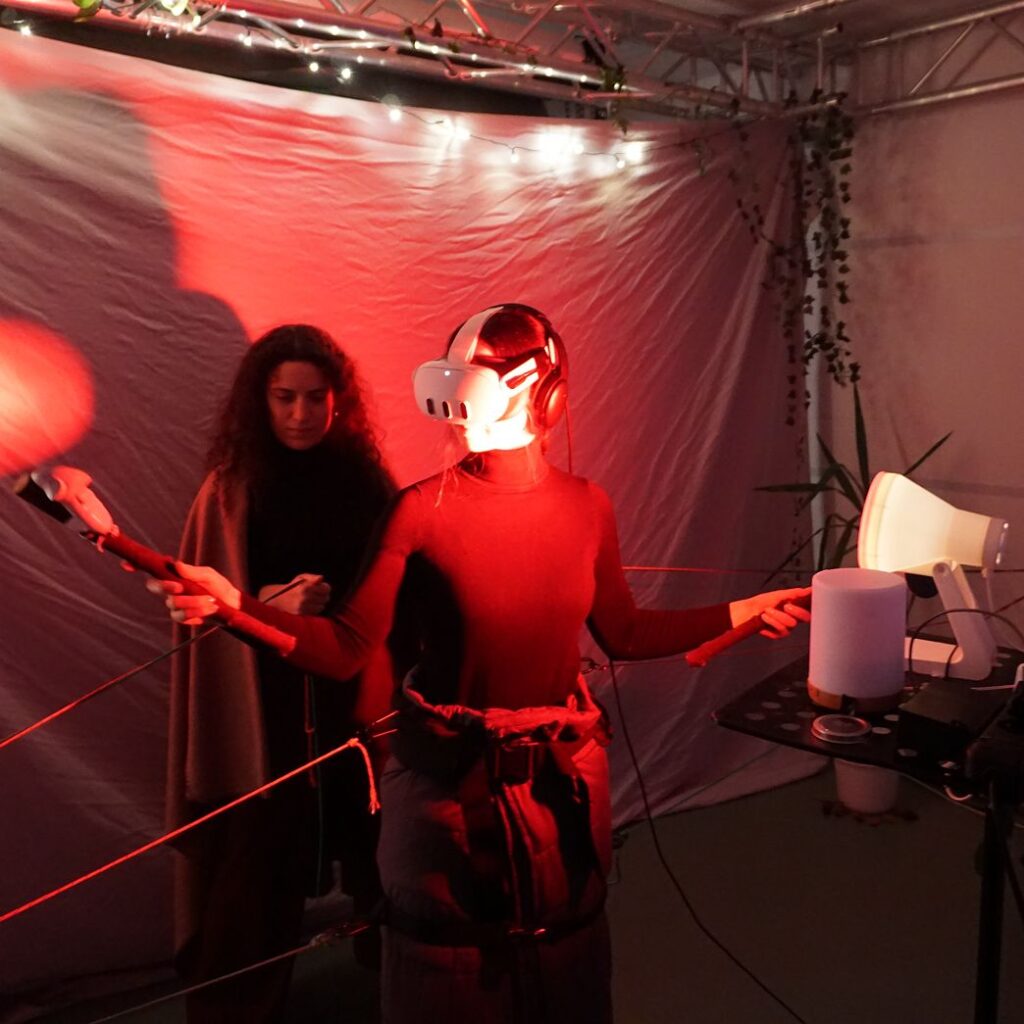
abstract = {Embodying natural entities in Virtual Reality (VR) shows potential to enhance nature connectedness, but design factors that support such embodiment remain underexplored. This study examined whether transitional elements in the physical setting before and after VR and multisensory stimuli during VR can strengthen nature connectedness in a transformative tree-embodiment experience. Through a mixed-methods approach (N=20), where we varied the pre- and post-VR experience (Neutral vs. Transitional) and sensory modalities (Audiovisual vs. Multisensory), we found that both transitional and multisensory experiences significantly enhanced presence, embodiment, and nature connectedness, with increases in emotional connectedness sustained one week later. Drawing on interview insights and impact ratings of specific design features, we derive design recommendations for integrating transitional and multisensory elements. Our findings demonstrate the value of holistic design for enhancing the emotional and transformative potential of virtual nature embodiment for fostering environmental awareness.},

keywords = {Honorable Mention, Papers},

pubstate = {published},

tppubtype = {inproceedings}

}
Experiencer, Helper, or Observer: Online Fraud Intervention for Older Adults Through a Role-based Simulation Approach
Yue Deng (The Hong Kong University of Science, Technology,, Max Planck Institute for Security, Privacy), Xiaowei Chen (Max Planck Institute for Security, Privacy), Junxiang Liao (The Hong Kong Polytechnic University), Bo Li (The Hong Kong University of Science, Technology), Yixin Zou (Max Planck Institute for Security, Privacy)
Honorable MentionAbstract | Tags: Honorable Mention, Papers | Links:
@inproceedings{Deng2026ExperiencerHelper,

title = {Experiencer, Helper, or Observer: Online Fraud Intervention for Older Adults Through a Role-based Simulation Approach},

author = {Yue Deng (The Hong Kong University of Science and Technology, and Max Planck Institute for Security and Privacy), Xiaowei Chen (Max Planck Institute for Security and Privacy), Junxiang Liao (The Hong Kong Polytechnic University), Bo Li (The Hong Kong University of Science and Technology), Yixin Zou (Max Planck Institute for Security and Privacy)},

url = {https://www.linkedin.com/in/yuedenghci/, author's linkedin},

doi = {10.1145/3772318.3791003},

year  = {2026},

date = {2026-04-13},

urldate = {2026-04-13},

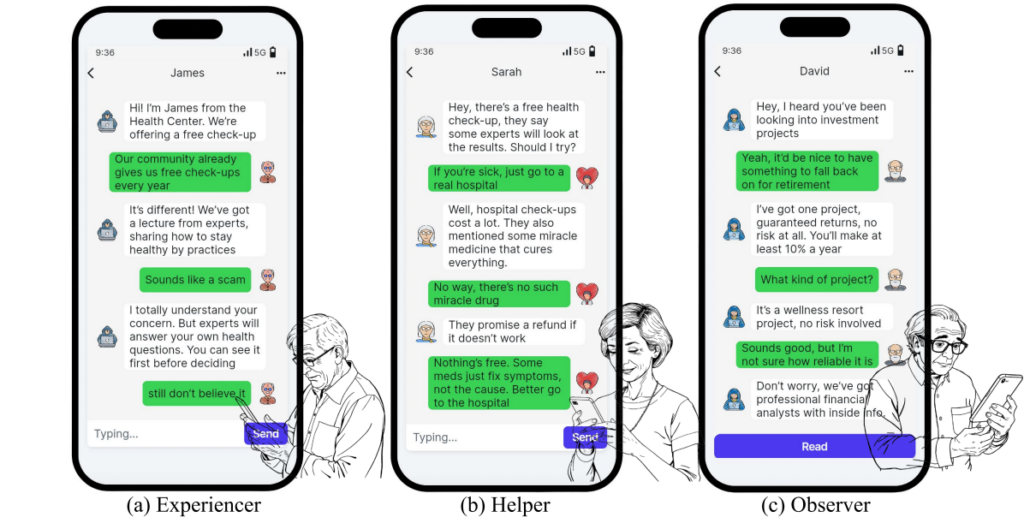
abstract = {Online fraud is a critical global threat that disproportionately targets older adults. Prior anti-fraud education for older adults has largely relied on static, traditional instruction that limits engagement and real-world transfer, whereas role-based simulation offers realistic yet low-risk opportunities for practice. Moreover, most interventions situate learners as victims, overlooking that fraud encounters often involve multiple roles, such as bystanders who witness scams and helpers who support victims. To address this gap, we developed ROLESafe, an anti-fraud educational intervention in which older adults learn through different learning roles, including Experiencer (experiencing fraud), Helper (assisting a victim), and Observer (witnessing fraud). In a between-subjects study with 144 older adults in China, we found that the Experiencer and Helper roles significantly improved participants' ability to identify online fraud. These findings highlight the promise of role-based, multi-perspective simulations for enhancing fraud awareness among older adults and provide design implications for future anti-fraud education.},

keywords = {Honorable Mention, Papers},

pubstate = {published},

tppubtype = {inproceedings}

}
Flow on Social Media? Rarer Than You’d Think
Michael T. Knierim (KIT, University of Nottingham), Thimo Schulz (KIT), Moritz Schiller (KIT), Jwan Shaban (University of Nottingham), Mario Nadj (University Duesburg-Essen), Max L. Wilson (University of Nottingham), Alexander Maedche (KIT)
Honorable MentionAbstract | Tags: Honorable Mention, Papers | Links:
@inproceedings{Knierim2026FlowSocial,

title = {Flow on Social Media? Rarer Than You’d Think},

author = {Michael T. Knierim (KIT, University of Nottingham), Thimo Schulz (KIT), Moritz Schiller (KIT), Jwan Shaban (University of Nottingham), Mario Nadj (University Duesburg-Essen), Max L. Wilson (University of Nottingham), Alexander Maedche (KIT)},

url = {https://h-lab.win.kit.edu/, website

https://www.linkedin.com/in/dr-michael-knierim-13397881/, author's linkedin},

doi = {10.1145/3772318.3791800},

year  = {2026},

date = {2026-04-13},

urldate = {2026-04-13},

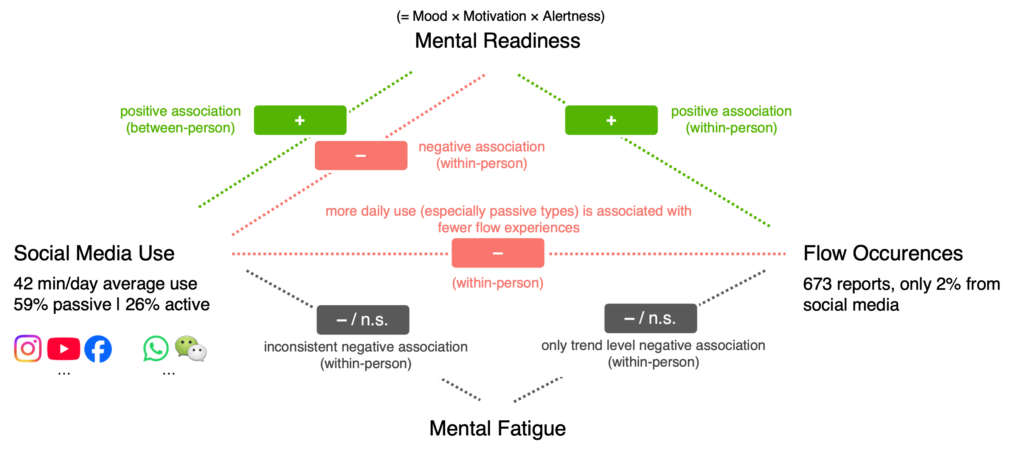
abstract = {Researchers often attribute social media’s appeal to its ability to elicit flow experiences of deep absorption and effortless engagement. Yet prolonged use has also been linked to distraction, fatigue, and lower mood. This paradox remains poorly understood, in part because prior studies rely on habitual or one-shot reports that ask participants to directly attribute flow to social media. To address this gap, we conducted a five-day field study with 40 participants, combining objective smartphone app tracking with daily reconstructions of flow-inducing activities. Across 673 reported flow occurrences, participants rarely associated flow with social media (2%). Instead, heavier social media use predicted fewer daily flow occurrences. We further examine this relationship through the effects of social media use on fatigue, mood, and motivation. Altogether, our findings suggest that flow and social media may not align as closely as assumed - and might even compete - underscoring the need for further research.},

keywords = {Honorable Mention, Papers},

pubstate = {published},

tppubtype = {inproceedings}

}
Hacking Flow: From Lived Practices to Innovation
Fabio Stano (KIT), Max L. Wilson (University of Nottingham), Christof Weinhardt (KIT), Michael T. Knierim (KIT, University of Nottingham)
Honorable MentionAbstract | Tags: Honorable Mention, Papers | Links:
@inproceedings{Stano2026HackingFlow,

title = {Hacking Flow: From Lived Practices to Innovation},

author = {Fabio Stano (KIT), Max L. Wilson (University of Nottingham), Christof Weinhardt (KIT), Michael T. Knierim (KIT, University of Nottingham)},

url = {https://www.linkedin.com/in/dr-michael-knierim-13397881/, author's linkedin},

doi = {10.1145/3772318.3791009},

year  = {2026},

date = {2026-04-13},

urldate = {2026-04-13},

abstract = {In digital knowledge work, flow promises not just productivity; it offers a pathway to well-being. Yet despite decades of flow research in HCI, we know little about how to design digital interventions that support it. In this work, we foreground lived interventions — everyday practices workers already use to foster flow — to uncover overlooked opportunities and chart new directions for digital intervention design. Specifically, we report findings from two studies: (1) a reflexive thematic analysis of open-ended survey responses (n = 160), surfacing 38 lived interventions across four categories: environment, organization, task shaping, and personal readiness; and (2) a quantitative online survey (n = 121) that validates this repertoire, identifies which interventions are broadly endorsed versus polarizing, and elicits visions of technological support. We contribute empirical insights into how digital workers cultivate flow, situate these lived interventions within existing literature, and derive design opportunities for future digital flow interventions.},

keywords = {Honorable Mention, Papers},

pubstate = {published},

tppubtype = {inproceedings}

}

I Felt Like I Need to Fit in Someone Else’s Body - Understanding Body-Centered UX Design for Online Fashion Shopping
Margarita Osipova (Bauhaus-Universität Weimar), Urszula Kulon (Bauhaus-Universität Weimar), Adithi Mahesh (Bauhaus-Universität Weimar), Olesia Kirillova (independent), Marion Koelle (Hochschule RheinMain), Eva Hornecker (Bauhaus-Universität Weimar)
Honorable MentionAbstract | Tags: Honorable Mention, Papers | Links:
@inproceedings{Osipova2026FeltLike,

title = {I Felt Like I Need to Fit in Someone Else’s Body - Understanding Body-Centered UX Design for Online Fashion Shopping},

author = {Margarita Osipova (Bauhaus-Universität Weimar), Urszula Kulon (Bauhaus-Universität Weimar), Adithi Mahesh (Bauhaus-Universität Weimar), Olesia Kirillova (independent), Marion Koelle (Hochschule RheinMain), Eva Hornecker (Bauhaus-Universität Weimar)},

url = {https://www.uni-weimar.de/en/media/chairs/computer-science-department/human-computer-interaction/, website

https://www.linkedin.com/in/eva-hornecker-8b34983/, lab's linkedin},

doi = {10.1145/3772318.3791225},

year  = {2026},

date = {2026-04-13},

urldate = {2026-04-13},

abstract = {Decades of online fashion retail and investment in its usability have led to a seemingly refined user experience. Yet, our study shows that female online shoppers, who make up the largest user group, experience a conflicted love-hate relationship when shopping online. Adopting a feminist HCI perspective, we contribute insights from a multi-step qualitative approach involving probes, co-design, iterative prototyping and body maps. We demonstrate that even screen-based website designs are deeply entangled with users’ embodied experiences. Through our analysis, we identify where such designs contribute to heightened emotional labour and negative user experiences. Our work offers concrete design implications centred around inclusivity, the predictive user experience of wearing and caring for garments, and transparency of information. We embody these implications in an interactive prototype and use it to validate our recommendations for a body-centred approach to UX design.},

keywords = {Honorable Mention, Papers},

pubstate = {published},

tppubtype = {inproceedings}

}
Out of Emergency: How Doctors Navigate Jurisdictional Seams in Emergency Care Referrals
Aloha Hufana Ambe (The University of Queensland, Australia), Isaac Salisbury (The University of Queensland, Australia), Tobias Grundgeiger (Julius-Maximilians-Universität Würzburg, Germany), Daniel Bodnar (Royal Brisbane, Women's Hospital, Australia), Sean Rothwell (Royal Brisbane, Women's Hospital, Australia), Dr Nathan Brown (Royal Brisbane, Women's Hospital, Australia), Ben Matthews (The University of Queensland, Australia)
Honorable MentionAbstract | Tags: Honorable Mention, Papers | Links:
@inproceedings{Ambe2026OutEmergency,

title = {Out of Emergency: How Doctors Navigate Jurisdictional Seams in Emergency Care Referrals},

author = {Aloha Hufana Ambe (The University of Queensland, Australia), Isaac Salisbury (The University of Queensland, Australia), Tobias Grundgeiger (Julius-Maximilians-Universität Würzburg, Germany), Daniel Bodnar (Royal Brisbane and Women's Hospital, Australia), Sean Rothwell (Royal Brisbane and Women's Hospital, Australia), Dr Nathan Brown (Royal Brisbane and Women's Hospital, Australia), Ben Matthews (The University of Queensland, Australia)},

url = {https://www.mcm.uni-wuerzburg.de/psyergo/, website},

doi = {10.1145/3772318.3790619},

year  = {2026},

date = {2026-04-13},

urldate = {2026-04-13},

abstract = {Referrals from the emergency department (ED) to inpatient teams are routine but high-stakes interactions, yet little is known about how they are accomplished in practice. Prior work often treats referrals as information transfer and emphasises structural tensions between departments, paying limited attention to the interactional detail of referral calls. To address this gap, we draw on a year of ethnographic fieldwork that includes seventeen recorded referral calls in a metropolitan ED. We show how clinicians manage jurisdictional seams through fine-grained conversational moves, and identify navigation strategies: tentative framing, preference-sensitive questioning, implicit acknowledgement of boundaries, offers of assistance and calibrated displays of competence. We demonstrate how the patient’s case is not treated as a fixed record but is reshaped in talk to align with different specialties, operating as a dynamic object. These insights extend accounts of boundary work and contribute to the design of supportive referral tools and training practices.},

keywords = {Honorable Mention, Papers},

pubstate = {published},

tppubtype = {inproceedings}

}
Show Me How to Play: Exploring Self-Modeling for Onboarding in Virtual Reality Exergames
Sukran Karaosmanoglu (Human-Computer Interaction, Universität Hamburg), Silas Ueberschaer (Human-Computer Interaction, Universität Hamburg), Sebastian Cmentowski (Industrial Design, Eindhoven University of Technology), Frank Steinicke (Human-Computer Interaction, Universität Hamburg)
Honorable MentionAbstract | Tags: Honorable Mention, Papers | Links:
@inproceedings{Karaosmanoglu2026ShowMe,

title = {Show Me How to Play: Exploring Self-Modeling for Onboarding in Virtual Reality Exergames},

author = {Sukran Karaosmanoglu (Human-Computer Interaction, Universität Hamburg), Silas Ueberschaer (Human-Computer Interaction, Universität Hamburg), Sebastian Cmentowski (Industrial Design, Eindhoven University of Technology), Frank Steinicke (Human-Computer Interaction, Universität Hamburg)},

url = {https://www.inf.uni-hamburg.de/en/inst/ab/hci.html, website

https://www.linkedin.com/in/frank-steinicke-b239639/, lab's linkedin

https://www.linkedin.com/in/sukran-karaosmanoglu/, author's linkedin},

doi = {10.1145/3772318.3790333},

year  = {2026},

date = {2026-04-13},

urldate = {2026-04-13},

abstract = {Exergames combine motivating game elements with bodily movement to encourage physical activity. However, onboarding players to perform correct movements remains a challenge, especially in virtual reality (VR) environments where safety and performance are critical. Drawing inspiration from sports training and learning sciences, we contrast two onboarding approaches: (i) trial-and-error and (ii) observational learning via a novel self-model tutorial. In this tutorial, players temporarily lose agency and observe their own avatar performing the movements, leveraging VR’s unique affordances for embodied experiences. To explore which of these two approaches yields a better performance and player experience, we conducted a between-participants study (N=60), comparing them against a baseline condition without a tutorial. Our findings show that the self-model tutorial not only improves players' performance but also increases the perceived ease of control and progress feedback. We discuss tradeoffs and implications for the design of future onboarding experiences in VR exergames.},

keywords = {Honorable Mention, Papers},

pubstate = {published},

tppubtype = {inproceedings}

}
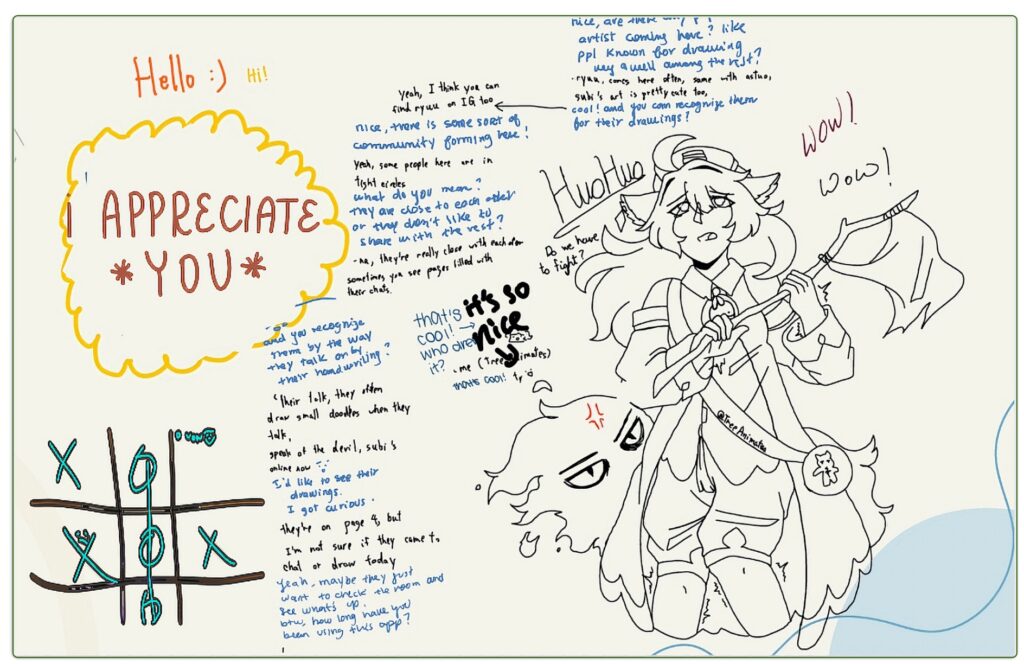
When Handwriting Goes Social: Creativity, Anonymity, and Communication in Graphonymous Online Spaces
Aditya Kumar Purohit ( CAIS ), Hendrik Heuer (CAIS)
Honorable MentionAbstract | Tags: Honorable Mention, Papers | Links:
@inproceedings{Purohit2026WhenHandwriting,

title = {When Handwriting Goes Social: Creativity, Anonymity, and Communication in Graphonymous Online Spaces},

author = {Aditya Kumar Purohit ( CAIS ), Hendrik Heuer (CAIS)},

url = {https://www.linkedin.com/in/adityakumarpurohit/, author\\\'s linkedin},

doi = {10.1145/3772318.3790828},

year  = {2026},

date = {2026-04-13},

urldate = {2026-04-13},

abstract = {While most digital communication platforms rely on text, relatively little research has examined how users engage through handwriting and drawing in anonymous, collaborative environments. We introduce Graphonymous Interaction, a form of communication where users interact anonymously via handwriting and drawing. Our study analyzed over 600 canvas pages from the Graphonymous Online Space (GOS) CollaNote and conducted interviews with 20 users. Additionally, we examined 70 minutes of real-time GOS sessions using Conversation Analysis and Multimodal Discourse Analysis. Findings reveal that Graphonymous Interaction fosters artistic expression, intellectual engagement, sharing and supporting, and social connection. Notably, anonymity coexisted with moments of recognition through graphological identification. Distinct conversational strategies also emerged, enabling smoother exchanges and fewer conversational repairs compared to text-based communication. This study contributes to understanding Graphonymous Interaction and Online Spaces, offering insights into designing platforms that support creative and socially engaging forms of communication beyond text.},

keywords = {Honorable Mention, Papers},

pubstate = {published},

tppubtype = {inproceedings}

}
With, not For: Co-Designing a Patient-Facing AI Companion Concept for the Emergency Department Waiting Area
Jacobe Klein (Freie Universität Berlin), Peter Sörries (Freie Universität Berlin), Yasemin Mutlugil (Freie Universität Berlin), Ceenu George (Technische Universität Berlin), Maria Altendorf (Charité - Universitätsmedizin Berlin), Martin Möckel (Charité - Universitätsmedizin Berlin), Claudia Müller-Birn (Freie Universität Berlin)
Honorable MentionAbstract | Tags: Honorable Mention, Papers | Links:
@inproceedings{Klein2026WithNot,

title = {With, not For: Co-Designing a Patient-Facing AI Companion Concept for the Emergency Department Waiting Area},

author = {Jacobe Klein (Freie Universität Berlin), Peter Sörries (Freie Universität Berlin), Yasemin Mutlugil (Freie Universität Berlin), Ceenu George (Technische Universität Berlin), Maria Altendorf (Charité - Universitätsmedizin Berlin), Martin Möckel (Charité - Universitätsmedizin Berlin), Claudia Müller-Birn (Freie Universität Berlin)},

url = {https://www.mi.fu-berlin.de/en/inf/groups/hcc/index.html, website

https://www.linkedin.com/in/jacobe-klein, author's linkedin},

doi = {10.1145/3772318.3790638},

year  = {2026},

date = {2026-04-13},

urldate = {2026-04-13},

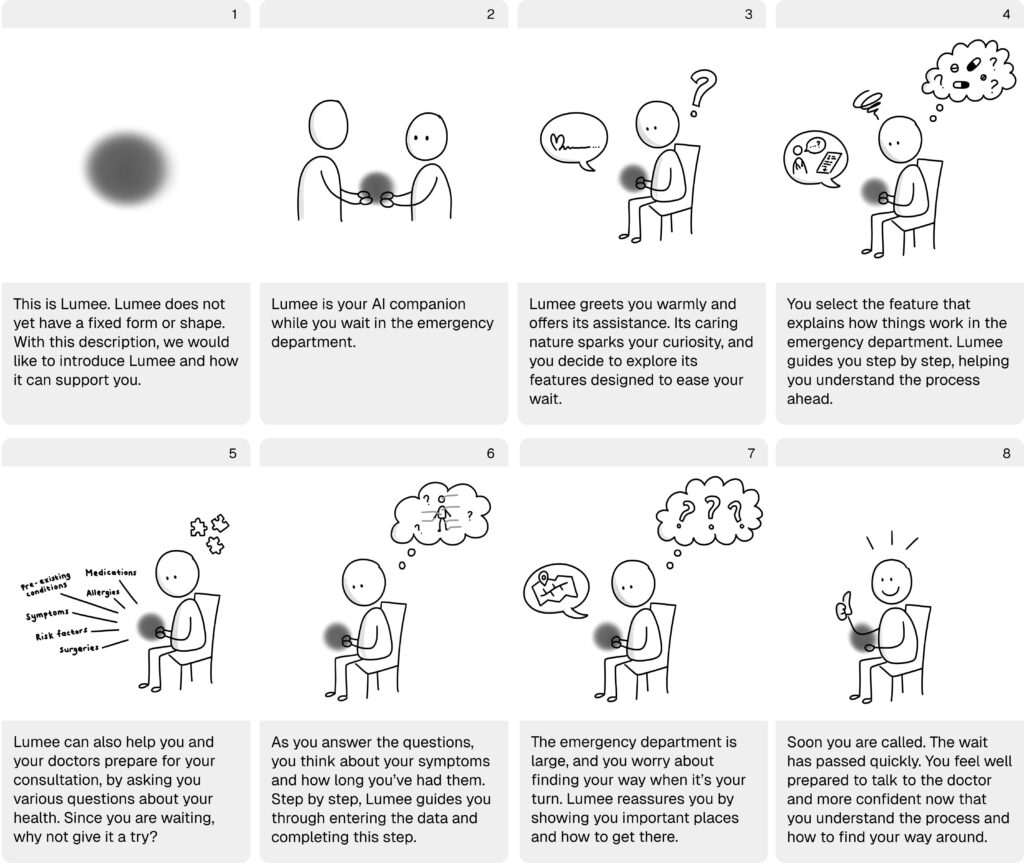
abstract = {Emergency departments (EDs) often experience overcrowding, staff shortages, and long waiting times, which put a strain on clinicians and negatively impact patients' experiences. Although AI is commonly proposed to optimize clinical workflows, the perspectives of patients are often overlooked in AI design. We report on a four-phase study at a university hospital combining preparatory fieldwork, co-creation workshops, design phase, and storyboard-guided interviews. Our findings reveal a misalignment: clinicians framed the contribution of AI around triage efficiency, while patients emphasized reassurance, empathy, and guidance. Addressing both needs, we developed and evaluated a concept of an ephemeral AI companion for the ED waiting area, designed to provide orientation, support reflection, and prepare patients for consultations without substituting human contact. We contribute: empirical evidence of patients’ needs, concerns, and expectations for AI support, design principles for an ephemeral AI companion concept, and findings from a study conducted with patients during their ED waits.},

keywords = {Honorable Mention, Papers},

pubstate = {published},

tppubtype = {inproceedings}

}
With, not For: Co-Designing a Patient-Facing AI Companion Concept for the Emergency Department Waiting Area
Jacobe Klein (Freie Universität Berlin), Peter Sörries (Freie Universität Berlin), Yasemin Mutlugil (Freie Universität Berlin), Ceenu George (Technische Universität Berlin), Maria Altendorf (Charité - Universitätsmedizin Berlin), Martin Möckel (Charité - Universitätsmedizin Berlin), Claudia Müller-Birn (Freie Universität Berlin)
Honorable MentionAbstract | Tags: Honorable Mention, Papers | Links:
@inproceedings{Klein2026WithNotb,

title = {With, not For: Co-Designing a Patient-Facing AI Companion Concept for the Emergency Department Waiting Area},

author = {Jacobe Klein (Freie Universität Berlin), Peter Sörries (Freie Universität Berlin), Yasemin Mutlugil (Freie Universität Berlin), Ceenu George (Technische Universität Berlin), Maria Altendorf (Charité - Universitätsmedizin Berlin), Martin Möckel (Charité - Universitätsmedizin Berlin), Claudia Müller-Birn (Freie Universität Berlin)},

url = {http://hcc.mi.fu-berlin.de/, website

https://www.linkedin.com/in/claudia-m%C3%BCller-birn-50443a359/, lab's linkedin

https://www.linkedin.com/in/jacobe-klein/, author's linkedin},

doi = {10.1145/3772318.3790638},

year  = {2026},

date = {2026-04-13},

urldate = {2026-04-13},

abstract = {Emergency departments (EDs) often experience overcrowding, staff shortages, and long waiting times, which put a strain on clinicians and negatively impact patients' experiences. Although AI is commonly proposed to optimize clinical workflows, the perspectives of patients are often overlooked in AI design. We report on a four-phase study at a university hospital combining preparatory fieldwork, co-creation workshops, design phase, and storyboard-guided interviews. Our findings reveal a misalignment: clinicians framed the contribution of AI around triage efficiency, while patients emphasized reassurance, empathy, and guidance. Addressing both needs, we developed and evaluated a concept of an ephemeral AI companion for the ED waiting area, designed to provide orientation, support reflection, and prepare patients for consultations without substituting human contact. We contribute: empirical evidence of patients’ needs, concerns, and expectations for AI support, design principles for an ephemeral AI companion concept, and findings from a study conducted with patients during their ED waits.},

keywords = {Honorable Mention, Papers},

pubstate = {published},

tppubtype = {inproceedings}

}